Milestone 0.2.0: End of the Sprint, or Why I'm Making This Game
It’s been 20 days since I first opened the Godot engine. Over the first weekend, I put together a basic prototype (v0.1.0) — the rifle fired, rabbits could be hunted. It felt like I just needed another week to finish the game. But I set the 3D client aside and shifted focus to shaping the core concept of the future virtual world.
I analyzed popular simulators on the market, from TheHunter Classic to Way of the Hunter 2, and noticed a specific problem with modern hunting and outdoor games. They suffer from gigantomania and don't respect the time of an adult player. We are offered 64-square-kilometer maps where you have to run for hours just for a single shot at an animal that functions essentially as a moving lootbox.
I decided to do things differently. Today, I am locking in my concept. This is my 'Save Point' before development shifts into a steady marathon.
What is this project about? (Architecture and Concept)
1. A Hybrid MMO and Nature Simulator
At its core, my game is a database divided into two parts:
Browser (Backend): Your headquarters. This is where you manage the economy, buy gear, analyze animal patterns, check trail cameras, and purchase licenses. You can do this during the day from your phone over a cup of coffee.
3D Client (Godot): The execution tool. You load into this for 20-30 minutes in the evening purely to take the shot (or cast a line) at a location you’ve already prepared.
2. Micro-Locations Instead of Empty Kilometers
I scrapped the idea of massive, procedurally generated wastelands. The game is planned to have 10 locations (from US forests and Amazon swamps to the Ukrainian steppes and Carpathians). Each map is a compact 200–300 hectares of hand-crafted level design with concentrated points of interest.
3. A Living Ecosystem and the 'Wildness Parameter'
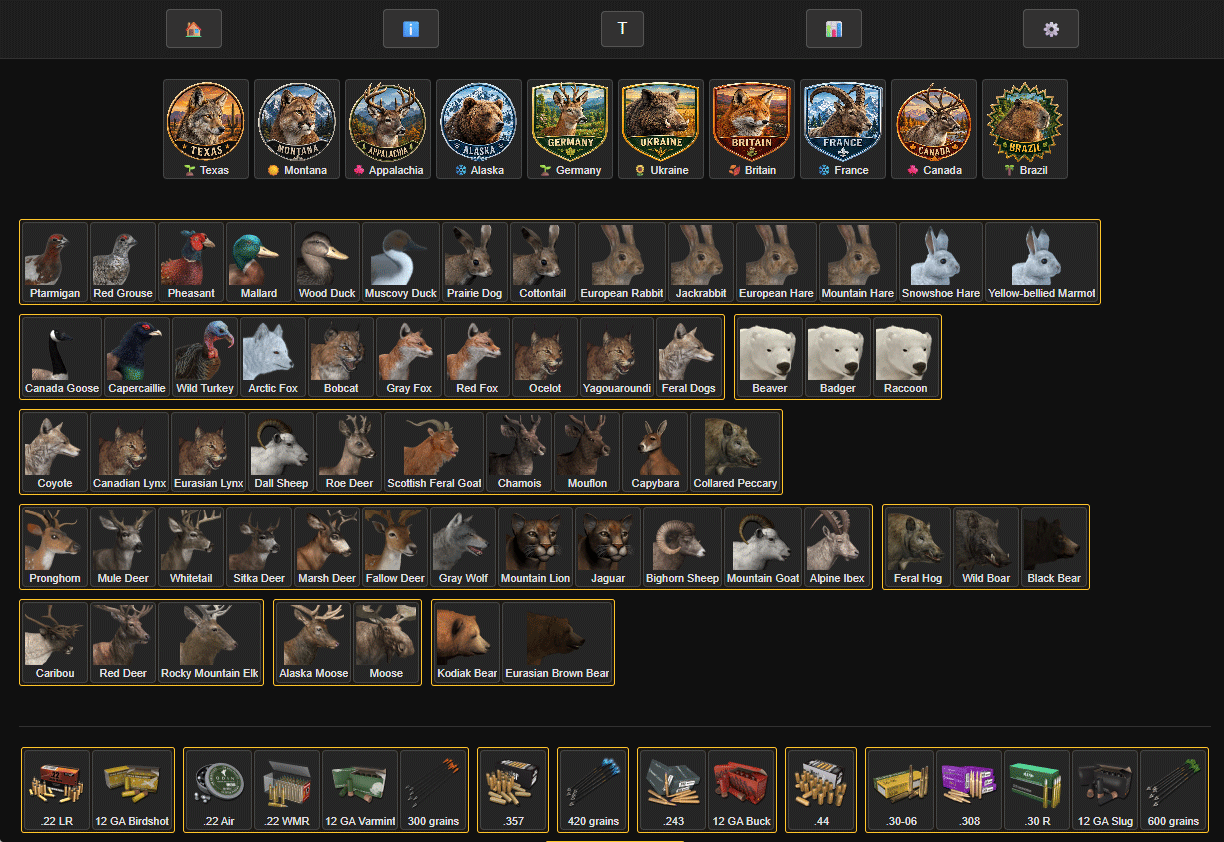
My database currently holds 60 unique animal and fish species (from whitetail deer to carp). Every species has its own sleep and feeding schedules. They aren't just targets. Found a raccoon? You can try feeding it. The world reacts to your ethics and actions.
4. Hardcore Without Artificial Limits
There will be no difficulty sliders. The world is equally unforgiving to everyone. A lack of experience and a cheap rifle will make your hunt a serious challenge. But once you save up for professional optics with a rangefinder, the game gets easier—because of your gear, not a menu setting.
What's Next?
These 20 days of brainstorming, researching geography, and calculating ballistics have exhausted me more than actually writing the code. Balancing this with running a business and surviving in Kyiv during a war is no easy task.
Because of this, the frantic 'pre-production' phase is now officially closed. The concept is locked in, and the data tables are ready. You can check all of this out on the project's website. My next step is to slowly build the backend (server-side) to breathe life into the 3D client.
I am not promising a release date 'tomorrow'. Instead, I’m inviting you into my engineering workshop. On Patreon, I’ll be posting devlogs: how I calculate the economy, how I link databases to Godot, and why I make certain design choices. On itch.io, I’ll be uploading technical prototypes (like my current v0.1.0 shooting range for testing ballistics).
If you want to see how a focused, system-deep simulator with a complex economy is built from scratch—join in. Let’s build this world together.
I analyzed popular simulators on the market, from TheHunter Classic to Way of the Hunter 2, and noticed a specific problem with modern hunting and outdoor games. They suffer from gigantomania and don't respect the time of an adult player. We are offered 64-square-kilometer maps where you have to run for hours just for a single shot at an animal that functions essentially as a moving lootbox.
I decided to do things differently. Today, I am locking in my concept. This is my 'Save Point' before development shifts into a steady marathon.
What is this project about? (Architecture and Concept)
1. A Hybrid MMO and Nature Simulator
At its core, my game is a database divided into two parts:
Browser (Backend): Your headquarters. This is where you manage the economy, buy gear, analyze animal patterns, check trail cameras, and purchase licenses. You can do this during the day from your phone over a cup of coffee.
3D Client (Godot): The execution tool. You load into this for 20-30 minutes in the evening purely to take the shot (or cast a line) at a location you’ve already prepared.
2. Micro-Locations Instead of Empty Kilometers
I scrapped the idea of massive, procedurally generated wastelands. The game is planned to have 10 locations (from US forests and Amazon swamps to the Ukrainian steppes and Carpathians). Each map is a compact 200–300 hectares of hand-crafted level design with concentrated points of interest.
3. A Living Ecosystem and the 'Wildness Parameter'
My database currently holds 60 unique animal and fish species (from whitetail deer to carp). Every species has its own sleep and feeding schedules. They aren't just targets. Found a raccoon? You can try feeding it. The world reacts to your ethics and actions.
4. Hardcore Without Artificial Limits
There will be no difficulty sliders. The world is equally unforgiving to everyone. A lack of experience and a cheap rifle will make your hunt a serious challenge. But once you save up for professional optics with a rangefinder, the game gets easier—because of your gear, not a menu setting.
What's Next?
These 20 days of brainstorming, researching geography, and calculating ballistics have exhausted me more than actually writing the code. Balancing this with running a business and surviving in Kyiv during a war is no easy task.
Because of this, the frantic 'pre-production' phase is now officially closed. The concept is locked in, and the data tables are ready. You can check all of this out on the project's website. My next step is to slowly build the backend (server-side) to breathe life into the 3D client.
I am not promising a release date 'tomorrow'. Instead, I’m inviting you into my engineering workshop. On Patreon, I’ll be posting devlogs: how I calculate the economy, how I link databases to Godot, and why I make certain design choices. On itch.io, I’ll be uploading technical prototypes (like my current v0.1.0 shooting range for testing ballistics).
If you want to see how a focused, system-deep simulator with a complex economy is built from scratch—join in. Let’s build this world together.